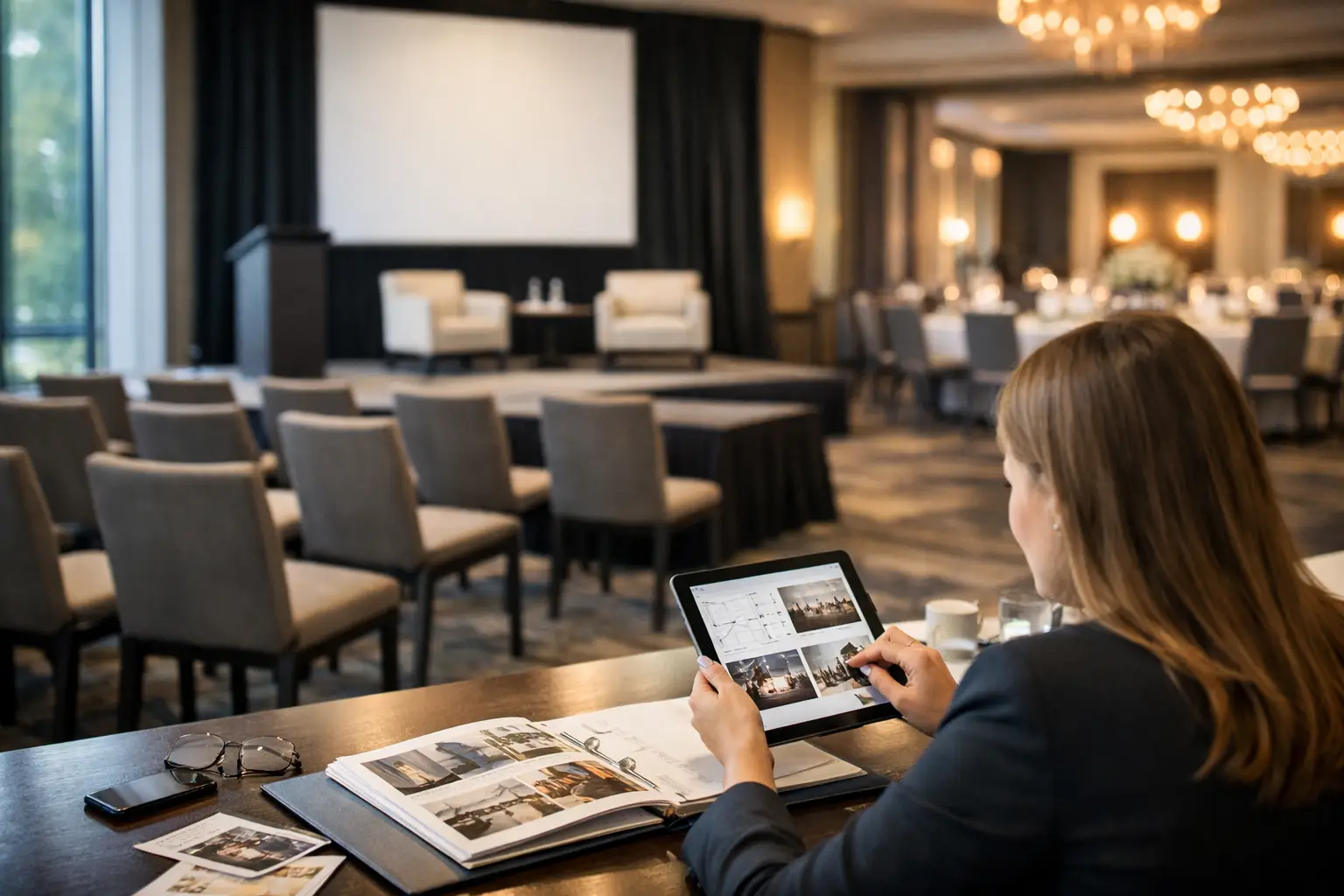
A conference brief rarely arrives with generous timescales, unlimited budget and complete stakeholder alignment. More often, it lands with a preferred month, a rough headcount, several competing priorities and a clear expectation that everything should run flawlessly. That is exactly why conference venue sourcing matters. Done well, it shortens decision-making, protects budget and removes a significant amount of pressure from internal teams.
For many organisations, the challenge is not simply finding a venue. It is finding the right venue, at the right rate, with the right availability, terms, location, accommodation options and operational fit. That process can absorb days of internal time before a shortlist is even ready. When multiple departments are involved, delays and missed details become expensive very quickly.
Conference venue sourcing is the process of identifying, evaluating, negotiating and securing a venue that fits the objectives of a business event. On paper, that can sound straightforward. In practice, it involves much more than checking capacity and comparing day delegate rates.
A suitable conference venue must support the format of the event, the profile of attendees and the standards expected by the business. A sales conference may need strong production capability, flexible breakout space and room for branding. A leadership meeting may require privacy, premium service and smooth overnight accommodation. A large internal conference may depend on transport links, efficient registration flow and food service that can handle high numbers without delays.
The venue itself is only one part of the decision. Contract terms, cancellation clauses, minimum spends, bedroom pick-up, access times, AV restrictions and supplier policies all shape the real value of the option. This is why a simple online search often creates more work than clarity.
Most corporate teams are balancing event planning with a wider role. Marketing managers are working across campaigns. Executive assistants are supporting senior leadership. HR and internal communications teams are managing employee engagement, policy and scheduling. Even experienced event managers can struggle when several projects peak at once.
Venue research becomes slow when every enquiry starts from scratch. One venue responds in two hours, another in three days, and another sends a generic brochure that does not answer the brief. Then the follow-up begins. Are the rates negotiable? Is exclusive use possible? Can the main room be turned around during lunch? Is there enough accommodation nearby if the hotel bedrooms sell out?
That back-and-forth is where time disappears. It also creates inconsistency. If each venue provides information in a different format, comparing them properly becomes harder. Teams can end up making a decision based on the most responsive venue rather than the best venue.
The strongest benefit of professional conference venue sourcing is speed, but speed on its own is not enough. Faster decisions only help if the shortlist is commercially sound and operationally realistic.
An experienced sourcing partner brings structure to the process. They take the brief, clarify the must-haves, approach suitable venues quickly and return options in a format that is easy to compare. That means stakeholders can review genuine choices rather than a collection of loosely relevant responses.
There is also a commercial advantage. Venues do not always lead with their best rate or most flexible terms. Negotiation can influence room hire, delegate packages, accommodation rates, upgrades, attrition allowances and added value. If you are booking regularly or working through a specialist with established supplier relationships, the outcome is often stronger than a one-off direct enquiry.
For busy corporate teams, the value is also practical. One point of contact managing venue conversations, holding space, chasing proposals and checking contract detail removes a large administrative burden. It gives internal stakeholders more control with less manual effort.
A polished brochure can hide operational compromises, so the sourcing stage needs to go beyond appearance. Capacity matters, but layout matters just as much. A venue that fits 300 theatre-style may not work for 300 cabaret with staging, camera positions and exhibition tables.
Location should be tested against delegate behaviour, not only postcodes. If most attendees are travelling by rail, a venue that is technically central but awkward to reach may reduce punctuality and satisfaction. If senior stakeholders are staying overnight, the quality and quantity of bedrooms become part of the event experience, not a separate booking issue.
Service delivery is another major factor. Some venues perform well for social events but lack the pace required for conferences with strict schedules. Others may offer attractive rates but have limitations on rigging, rehearsal access or external suppliers. These details affect the running of the day and should be addressed before contracts are signed.
Budget should also be assessed in full. A lower headline package is not always cheaper once AV, Wi-Fi, staging, security, cloakroom staffing and accommodation are added. Good sourcing creates a realistic total cost picture early, which helps avoid unpleasant surprises later.
The best sourcing process is clear, quick and disciplined. It starts with a brief that captures objectives, preferred dates, audience profile, layout, location, budget parameters and any non-negotiables. At this stage, clarity saves time later. If stakeholders are vague on priorities, the shortlist can easily drift.
Once the brief is set, appropriate venues are approached in parallel. Responses are assessed not only on availability and price, but on fit, flexibility and commercial terms. Weak options are filtered out before they reach the client, which makes internal review faster.
The next stage is negotiation. This is where expertise makes a visible difference. Rate reductions are useful, but so are better concession terms, stronger cancellation wording, improved upgrade options and practical extras that support delivery on the day.
Site visits or virtual reviews then confirm whether the leading options match expectations. Final selection should happen with contract detail already understood, not left until after the preferred venue is chosen. That order matters because risk often sits in the small print.
Conference planning becomes harder when venue booking and delegate accommodation are treated as separate projects. The venue may look right until bedroom availability tightens. Hotel rates may rise while internal approval is still pending. Delegates may end up spread across several properties with inconsistent booking arrangements.
A joined-up approach is more efficient. When conference venue sourcing is managed alongside accommodation planning, teams get a clearer view of total event logistics. They can assess whether staying onsite is realistic, whether overflow hotels are required and how transport will work between locations.
This matters even more for multi-day conferences, annual meetings and events with international attendees. A venue that performs well for the meeting itself can still create unnecessary friction if bedroom inventory, check-in flow or local hotel options are weak. Looking at the wider delegate journey helps prevent that.
Some internal teams are well equipped to source venues directly, especially for repeat events in familiar locations. But there are clear scenarios where external support adds immediate value.
Tight deadlines are the most obvious. If a business needs a proposal quickly, relying on ad hoc venue outreach can slow everything down. High-value or high-visibility events also benefit from a specialist eye, because mistakes at contracting stage or gaps in venue suitability can be difficult to recover from.
Outsourcing also makes sense when procurement discipline is required but internal resource is limited. A professional sourcing partner can provide a more efficient market comparison, stronger negotiation and a cleaner approval path. For organisations running multiple events each year, that consistency becomes especially useful.
This is where a service-led partner can make a measurable difference. International Events, for example, is built around exactly this pressure point: sourcing suitable venues quickly, returning detailed proposals within 12 working hours and helping clients reduce workload without adding venue-finding fees.
Not all venue-finding support is equal. Some providers simply pass on options. Others actively shape the process, challenge weak assumptions and protect the client from avoidable cost or risk.
A good partner should ask smart questions early, present options clearly and explain trade-offs honestly. If one venue is cheaper but less flexible, that should be made clear. If another is stronger operationally but weaker on accommodation, that should be highlighted too. Corporate clients need decisions they can defend internally, not just a stack of brochures.
Responsiveness matters as well. Event timelines move quickly, and delays in sourcing create delays everywhere else. A dependable partner should feel like an extension of the team – proactive, commercially aware and easy to reach when priorities shift.
The right venue can improve attendance, simplify logistics and make the whole event feel more polished. The right sourcing process does something just as valuable: it removes wasted time, sharpens commercial decisions and gives your team room to focus on the event itself rather than the chase. If you are planning under pressure, that breathing space is often what makes the difference.

Choose the best conference hotels for delegates with a practical checklist covering location, bedrooms, meeting space, service, budget and booking control.
Read more
Compare the best delegate management platforms for corporate events, from registration and payments to reporting, integrations and hands-on support teams.
Read more
See a corporate event budget savings example showing how focused venue sourcing, hotel strategy and tighter supplier control can reduce your total spend.
Read more
Copyright International Events Incorporated.
All rights reserved
Copyright International Events Incorporated.
All rights reserved

Fill in the following details. We respect your privacy, we don’t spam.
Fill in the following details. We respect your privacy, we don’t spam.  Or call us on 07715 242282
Fill in the following details. We respect your privacy, we don’t spam. Or call us on 07715 242282


 Enquire now


