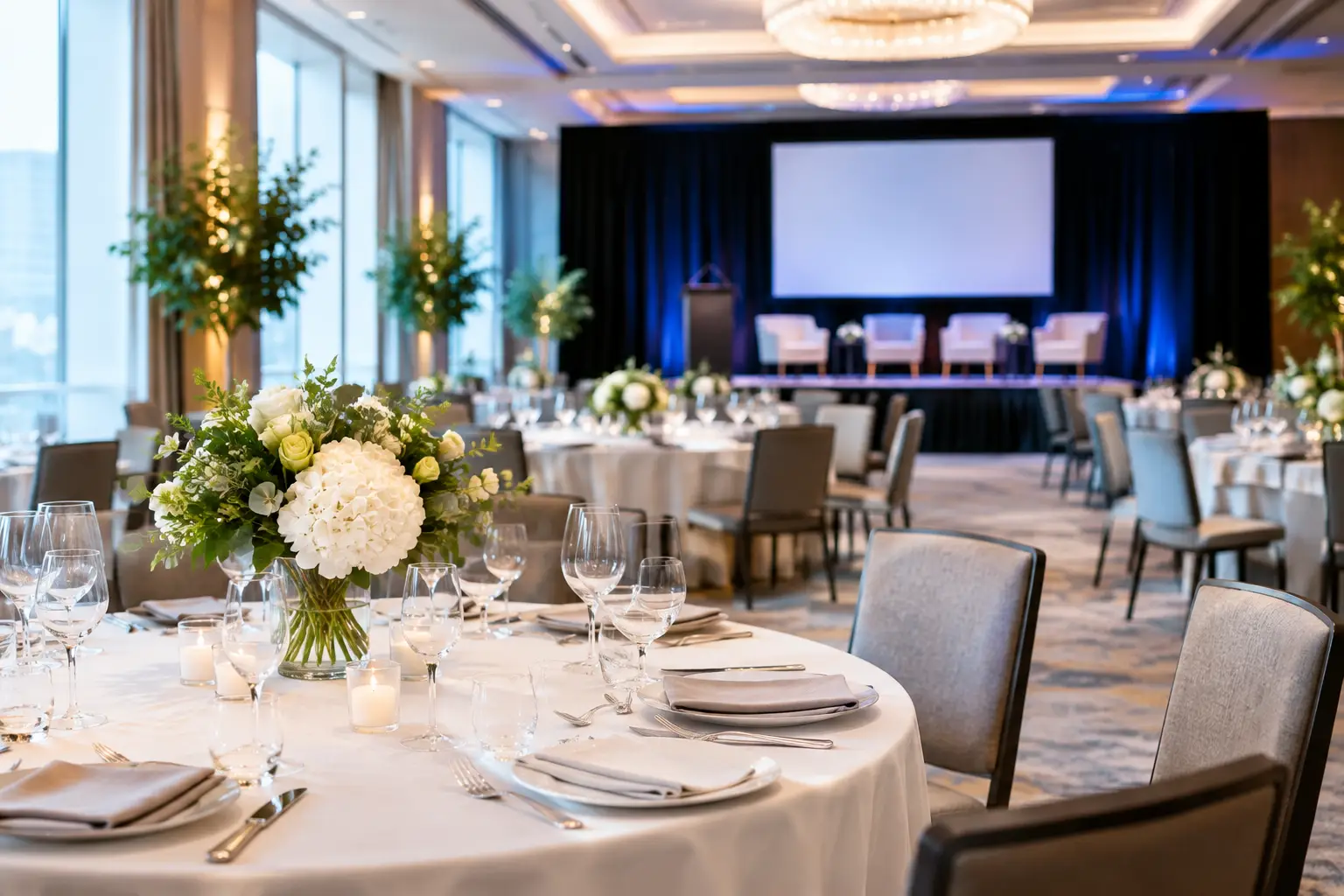
A venue quote can look deceptively simple: room hire, catering, bedrooms and a total at the bottom. Yet when a venue finder says its sourcing service is free, many corporate planners understandably ask where the money comes from. Venue commission explained clearly means there are no surprises, no unnecessary layers of cost and no uncertainty when procurement asks how the arrangement works.
For most corporate events, venue commission is a standard commercial arrangement between the venue and the agency that introduces and manages the booking. It allows an experienced venue-finding partner to research options, negotiate, coordinate proposals and save your team considerable time without charging an upfront sourcing fee.
Venue commission is a payment made by a hotel, conference centre or event venue to a venue-finding agency after a confirmed booking takes place. It is typically calculated as a percentage of eligible event spend, such as meeting room hire, food and beverage, accommodation or agreed day delegate rates.
The commission is paid by the supplier, not added as a separate client charge for venue finding. In practice, venues build the cost of sales and distribution into their overall commercial model, whether an enquiry arrives directly, through an agency or via another booking channel. A good agency should be open about this from the outset and explain exactly what is, and is not, included in its service.
That distinction matters. Free venue finding does not mean a less rigorous search or a limited shortlist. It means the agency is remunerated by the venue when a booking is confirmed, while your team receives professional sourcing support without a separate venue-search invoice.
The process should be straightforward. You provide the brief: dates, location, delegate numbers, room layout, bedroom requirements, budget, accessibility needs and the purpose of the event. Your venue partner then approaches suitable venues, gathers availability and puts forward comparable options.
Once you select a venue, the booking is contracted. Depending on the arrangement, the contract may be directly between your organisation and the venue, or the agency may manage elements of the contracting process on your behalf. After the event has taken place and the venue has received payment under its terms, it pays the agreed commission to the agency.
This model rewards efficient sourcing, but it should never replace sound advice. The right venue is not simply the one offering the highest commission. It is the one that meets the brief, protects the budget, supports the delegate experience and gives the event the operational certainty it needs.
For a one-day leadership meeting, that may mean prioritising easy rail access, reliable AV and a private dining space. For a sales conference with overnight delegates, bedroom allocation, meeting flow, evening entertainment and attrition terms may carry far more weight. The recommendation should reflect those priorities, not a generic list of available properties.
Not necessarily. This is the question every budget holder should ask, and the honest answer depends on the venue, dates, scale of the event and commercial terms.
A well-connected venue finder can often negotiate rates or added value that an individual organiser may not secure alone. Regular booking volume gives agencies insight into realistic market pricing, seasonal availability and which concessions are worth requesting. That might include complimentary bedrooms, upgraded Wi-Fi, reduced room hire, improved payment terms or flexibility around set-up access.
However, the lowest headline rate is not always the lowest total cost. A cheaper venue outside the right location can increase travel expenses and reduce attendance. An attractive day delegate rate can become less competitive once AV, staffing, security, late finishes and catering upgrades are added. A venue with tight cancellation or minimum-spend terms can create avoidable exposure if delegate numbers change.
The value of an agency is therefore not just in obtaining a price. It is in helping you compare like with like and identify the costs, conditions and operational risks that may otherwise emerge too late.
Commission works best when it is supported by a clear process. You should expect a venue-finding partner to explain its commercial model without hesitation and to provide proposals that make decision-making easier.
A useful proposal will set out the venue name and location, available dates, capacities, estimated costs, key inclusions and important exclusions. It should also flag the terms that affect your risk, including cancellation schedules, bedroom release dates, minimum spends, VAT treatment and any service charges. If a quote is provisional, that should be clear too.
For larger conferences, you may also need visibility of accommodation allocations, meeting-space exclusivity, loading access, branding opportunities, accessibility provisions and supplier restrictions. These details are not administrative footnotes. They can determine whether an event runs smoothly or becomes difficult to manage on the day.
At International Events, venue sourcing is designed to remove this workload from internal teams, with detailed venue proposals available within 12 working hours where the brief and supplier response allow. The focus is on presenting viable choices quickly, then managing the detail needed to keep the event on brand and on budget.
Free venue finding and free event management are not the same service. Sourcing and securing a venue can be commission-funded, while broader event support may require a management fee. This is particularly common when an agency is asked to manage registration, production, creative, transport, speaker logistics, delegate communications, on-site staffing or multiple third-party suppliers.
That is not a drawback. It simply reflects the work involved. The key is to separate the services clearly so you know what is covered by venue commission and what requires additional budget.
There are also situations where a venue commission may not be available. A preferred venue might not pay commission, an overseas supplier may work differently, or a complex procurement route may require a fixed-fee model. In those cases, a reputable agency should explain the position and agree any client fee before work begins.
A quick conversation at the start can prevent confusion later. Ask whether the service is commission-funded, whether you will be charged any sourcing or booking fee, and whether the agency can disclose how it is remunerated. You should also ask who will hold the contract, who manages changes after confirmation and whether the quoted prices include VAT, service charges and all mandatory fees.
For conferences with bedrooms, ask about attrition, cut-off dates and how unbooked rooms are treated. For events with production or entertainment, establish whether the venue has exclusive suppliers and whether those costs have been included. If you are working to a firm ceiling, state it early. A good partner will shape the search around the full spend, not just the room-hire line.
The strongest benefit of a commission-based venue-finding service is often time. Internal event owners can lose days researching venues, chasing availability, comparing inconsistent proposals and coordinating contract questions across several stakeholders. That effort has a cost, even if it never appears on the event budget.
An experienced partner centralises those moving parts. It gives your team one point of contact, a clearer route to approval and greater confidence that the venue can deliver what has been promised. For teams managing a conference alongside their day job, that control is often as valuable as a negotiated rate.
Before issuing your next venue brief, ask for clarity rather than assuming the word “free” tells the whole story. When commission, scope and responsibilities are transparent, you can use the model for what it should deliver: a faster route to the right venue, with less pressure on your team and more control over the event outcome.

Choose the best corporate event formats for your objectives, budget and audience, with practical planning advice to keep delivery polished and on track.
Read more
See a delegate booking consolidation example that cuts admin, controls hotel costs and gives your event team one clear point of contact from start to finish.
Read more
Know when to use corporate room blocks to reduce accommodation costs, protect attendance and simplify hotel coordination for business events at scale.
Read more
Copyright International Events Incorporated.
All rights reserved
Copyright International Events Incorporated.
All rights reserved

Fill in the following details. We respect your privacy, we don’t spam.
Fill in the following details. We respect your privacy, we don’t spam.  Or call us on 07715 242282
Fill in the following details. We respect your privacy, we don’t spam. Or call us on 07715 242282


 Enquire now


