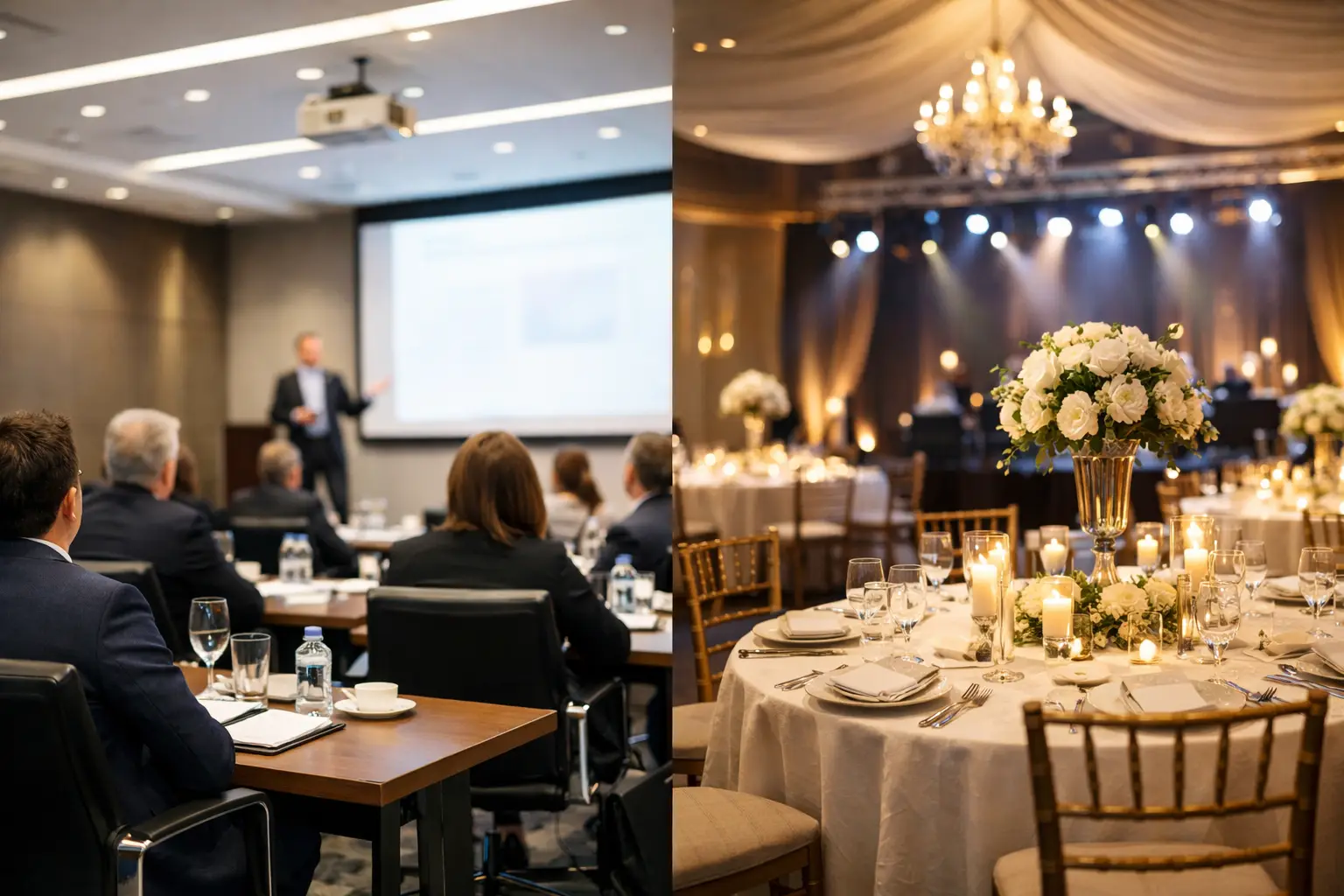
A venue can look perfect on a site visit and still create unnecessary pressure on event day. Perhaps the meeting rooms are impressive, but delegates face a 25-minute transfer from their hotel. Or the hotel has excellent bedrooms, yet its largest conference suite leaves little room for staging, exhibition stands or a proper networking area. When comparing conference hotels vs event venues, the right choice comes down to more than capacity and room hire.
For corporate planners, the decision affects attendance, budgets, logistics and the impression the event makes. A conference hotel can bring accommodation, meeting space and catering under one roof. A dedicated event venue can provide a more distinctive setting, greater production freedom and a stronger fit for a high-impact agenda. Neither is automatically better. The priority is to match the setting to the event’s purpose and the practical needs of the people attending.
Think through the event from the delegate’s perspective. Where do they arrive? How easily can they find the registration desk? Is there time to check in, meet colleagues and prepare before the first session? What happens between the conference, dinner and evening networking?
Conference hotels tend to reduce the number of moving parts. Delegates can sleep, eat, meet and socialise in one location. That is particularly valuable for multi-day conferences, leadership meetings, training programmes and events with guests travelling from across the UK or overseas. Less travel between programme elements means fewer late arrivals and less reliance on coaches, taxis or individual expense claims.
Dedicated event venues can create a more memorable arrival and a sharper break from the working day. A museum, gallery, private members’ club, stadium or contemporary event space may better reflect the occasion, especially for a product launch, awards dinner, company celebration or client-facing event. The trade-off is that accommodation and transport usually need to be sourced and coordinated separately.
The key question is not whether delegates would enjoy the venue. It is whether the venue supports the full experience without adding avoidable friction for your audience.
A conference hotel is often the most efficient option where accommodation is central to the event. This is not just about convenience. Keeping delegates on site gives organisers more control over timings, attendance and informal interaction, which can be just as valuable as the formal conference programme.
If a significant proportion of delegates are travelling, an on-site bedroom allocation simplifies planning. Organisers can arrange a single booking process, manage rooming lists and provide delegates with one clear itinerary. It also makes early starts, late finishes and evening dinners easier to deliver without worrying about onward travel.
For international guests or senior leaders with limited time, this simplicity has real value. A reliable airport transfer route, appropriate room types and a smooth check-in process can shape their view of the event before the opening presentation begins.
Residential conferences work well when the programme depends on discussion outside the meeting room. Leadership off-sites, strategy sessions and team development events benefit from shared meals, informal conversations and the ability to continue networking after scheduled sessions end.
Hotels also provide useful contingency options. If a breakout group needs a quiet room, a speaker needs a private preparation space or bad weather changes outdoor plans, the events team may be able to adapt more quickly within an established venue operation.
One contract can cover meeting rooms, bedrooms, catering and many core event requirements. That does not mean every hotel package represents the best value, but it can make budget management more straightforward. The organiser has fewer suppliers to brief, fewer invoices to reconcile and a clearer escalation route if an issue arises.
That said, not all conference hotels are equal. Check the meeting space independently of the bedrooms. A hotel with excellent accommodation may have low ceilings, limited natural daylight, awkward room shapes or a layout that makes exhibition and networking difficult. Ask to see the room set in the configuration you need, not simply empty on a site visit.
Dedicated venues are designed to make an occasion feel different. They can give a conference or celebration a sense of place that a standard hotel function room may not provide, particularly where brand perception, production quality or guest experience is the main priority.
For a product reveal, awards ceremony, press event or customer conference, the environment becomes part of the message. A venue with character can reinforce a brand story, create better photo opportunities and give delegates a reason to remember the event beyond the content on stage.
These spaces often offer more creative flexibility too. You may have greater scope for branded registration areas, custom staging, themed catering stations, immersive activations and exhibition layouts. This is useful when the event needs to feel tailored rather than packaged.
A purpose-built venue may be better equipped for high-specification audiovisual production, larger audiences, vehicle access, rigging, multiple concurrent spaces or an extensive exhibition. It can also offer more freedom over approved suppliers, although this varies considerably and should be confirmed before contracting.
Do not assume greater flexibility means less structure. Some venues have strict load-in windows, sound limits, exclusive catering arrangements or requirements to use in-house technical teams. These terms can be entirely reasonable, but they need to be understood early because they affect both the schedule and the final cost.
If most attendees are based nearby and the programme runs for one day, separate accommodation may be irrelevant. In this situation, choosing a destination event venue can be a better use of budget than paying for hotel infrastructure delegates will not need.
The practical test is accessibility. Consider rail connections, parking, step-free access, local transport and how guests will leave after an evening reception. A distinctive venue loses its appeal if the journey home is difficult for a large portion of the audience.
Room hire is rarely the figure that determines the final budget. The more useful comparison is the total delivered cost of the event, including all essential services and the work required to coordinate them.
At a conference hotel, assess the day delegate rate or meeting package alongside bedroom rates, minimum catering spends, parking, Wi-Fi, audiovisual equipment and any staffing charges. Check whether the quoted rate includes the meeting room for the full access period you need, rather than just delegate hours. Early access for set-up and later access for pack-down can make a material difference.
At an event venue, factor in the cost of hotels, transfers, security, furniture, catering, production, branding, cloakroom staff and any temporary infrastructure. A lower venue hire fee can quickly become more expensive if every element must be supplied separately. Conversely, a venue that appears premium may be better value once it reduces the production needed to create the right atmosphere.
Also look at the commercial terms. Attrition clauses on bedroom blocks, cancellation schedules, minimum spends and payment dates should match the level of certainty you have around attendance. For a growing guest list, the ability to release unused bedrooms or add capacity later may be worth more than a small saving on the initial rate.
A focused brief produces better venue options and avoids time being spent on spaces that only meet the basic capacity requirement. Before approaching suppliers, establish these five points:
With this detail in place, the comparison becomes clearer. A hotel proposal should demonstrate how it will keep the programme together and delegates comfortable. An event venue proposal should show how it will deliver the desired impact without creating unmanageable logistics.
The most effective decision-making process looks beyond the venue in isolation. A space might be available on the preferred date, but the surrounding hotels may be fully booked. Another may offer attractive room hire, but require expensive production or complicated supplier coordination. Reviewing venue, accommodation, transport and event delivery together prevents late-stage compromises.
This is where an experienced venue-finding partner can save substantial internal time. International Events can source and compare suitable options, negotiate with suppliers and return a detailed venue proposal within 12 working hours. Having a single point of contact also makes it easier to assess the operational impact of each option, rather than collecting disconnected quotes from multiple providers.
Choose the setting that makes it easier for delegates to participate, for stakeholders to approve the budget and for your team to deliver with confidence. The best venue is the one that supports the event you are actually running, not simply the one with the most impressive brochure.
When are event deposits refundable? Understand contracts, cancellation terms and force majeure to protect your corporate event budget and booking plans.
Read more
Choose the best conference hotels for delegates with a practical checklist covering location, bedrooms, meeting space, service, budget and booking control.
Read more
Compare the best delegate management platforms for corporate events, from registration and payments to reporting, integrations and hands-on support teams.
Read more
Copyright International Events Incorporated.
All rights reserved
Copyright International Events Incorporated.
All rights reserved

Fill in the following details. We respect your privacy, we don’t spam.
Fill in the following details. We respect your privacy, we don’t spam.  Or call us on 07715 242282
Fill in the following details. We respect your privacy, we don’t spam. Or call us on 07715 242282


 Enquire now


